This page provides a summary of three different approaches to songwriting in music lessons. Further links and literature are also listed for each approach.
Content
Reflection-oriented model for songwriting with AI: The Songcircle
The Song Circle consists of two levels:
- the songwriting level maps various parameters, components and procedures with and without AI, as well as different paths of the creative process,
- the reflection level includes a critical-constructive perspective on one's own actions when dealing with digital tools and AI in particular.
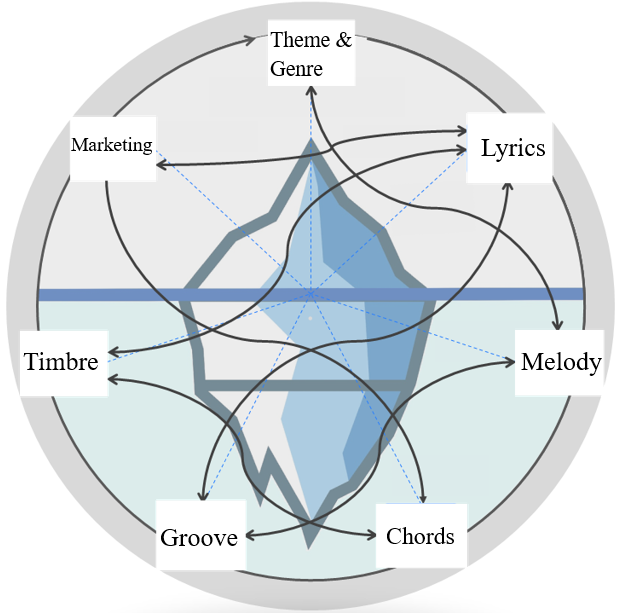
Song circle
Lizenz: CC-BY-4.0
The songwriting level: Aspects such as theme and genre, lyrics, melody, chords, groove, samples and sound design, as well as the development of a marketing strategy, can be taken into account when developing a song. AI can be used as a partner in the creative process for the design of each component, or it can be consciously . The individual components can either be worked on one after the other in a linear process (as with Song Stripe) or you can start with a component of your choice and (similar to the four-room model) follow your own intuition and preferences to jump to another component and switch back and forth as you wish.
The reflection level: The reflection level picks up on the Technology Education Iceberg developed by Pleasants et al. (2023). Each component of the songwriting process is used as an opportunity for reflection in order to critically and constructively question the influence of AI on one's own creative work. More information on the Technology Education Iceberg can be found here.
Coming and going: In the expanded version shown below, the model also includes some suggestions for topics that can be addressed either before or after songwriting. Conversely, these topics can also be used to take a brief detour to certain components of songwriting.
Sources & further reading on the iceberg model
- Krutka, D. G., Pleasants, J., & Nichols, T. P. (2023). Talking the technology talk. Phi Delta Kappan, 104(7), 42-46.
The Song Stripe (German only)
The Song Stripe is a songwriting concept developed by Andreas Walter (music trainer and music teacher) and tested extensively in the classroom. It consists of a central task card with assignments that contain links to additional task cards with information on specific subtopics, such as chord progressions in rock and pop songs. Students are guided step by step through the songwriting process along the parameters of a song. In some places, this is didactically reduced, e.g. by limiting it to the genres of singer-songwriter and hip hop, and contains a lot of helpful tips. The Song Stripe forms an important starting point for the teaching materials suggested in this self-study module.
The Song Stripe can be viewed here.
Sources & further reading on the Song Stripe
- Fritsch, M. (2020). Harmony and songwriting (8th rev. and expanded ed.). Leu-Verlag.
- Gesing, F. (2014). Creative writing: Craft and techniques of storytelling. DuMont Buchverlag.
- Lamberts-Piel, C. (2022). Songwriting: EinFach Musik. Westermann Bildungsmedien.
- Masen, A. (2015). More than just words: Writing successful song lyrics. Schott Music.
- musikwissen.com (n.d.). Pop cadences: Harmonic progressions in pop music.
- Schmidt, A. (2010). Songwriting: 40 ways to your own song. Schott Music.
The Four-Room Model (MusCoDA Project)
Another songwriting concept was developed as part of the research project >>Musical Communities in the Post-Digital Age (MusCoDA)<< conducted by the universities of Erfurt and Paderborn. It builds on Lucy Green's work on informal learning in pop music and on research findings on post-digital music-making practices, such as the songwriting processes of informal bands.
In the Four-Room Model, songwriting is understood as the interconnection of ideas, people and (digital) things in a post-digital world in which analogue and digital elements can influence and permeate each other. Accordingly, the concept of the four-space model encourages students to network with other people and their ideas in analogue and digital space, to incorporate a wide variety of analogue and digital things, and to consider the publication of their song as networking with a specific target group from the outset.
The Four-Room Model includes an overarching task and cards with reflection questions for each space. Each space focuses on a set of specific, related actions, e.g. “explore and collect”. The questions on the cards are intended to provide students with initial starting points and encourage them to reflect on their actions.
The concept development process also resulted in the card game >>Write Your Song!<<, which can be used by teachers to plan songwriting processes and by students to structure their work.
8 school lessons or 4 double lessons
"As a solo artist or band, you should perform your own song live in front of an audience or as a music video (TikTok, YouTube, etc.) or place it in a playlist.
Goal: Reach your target audience with your performance! To do this, you should move back and forth, forwards and backwards, constantly and continuously through four rooms (modes).
To-do: Network and use all possible people and apps, devices, technologies, etc. Involve friends, acquaintances, family, your audience or professionals you know personally, indirectly or through other channels (Instagram, etc.). Anything that helps you is allowed, except covers!"
The task is also explained in more detail in the following video for students:
Quelle: YouTube
In addition, students receive the cards shown below with thought-provoking questions about the various songwriting rooms. If four physical rooms are provided, the cards are also displayed here.
The card set can be downloaded (english PPTX-File is included in the Zip) here.
Planning and structuring songwriting with the card game >>Write Your Song!<<
Although the card game >>Write Your Song!<< was developed in the context of the four-room model, it can also be used independently of this. It aims to be both a planning tool for teachers and a structuring aid for pupils in the songwriting process. A hybrid form is also possible, in which teachers pre-structure parts of the songwriting process and then make some outstanding decisions together with the class with the help of the card game.
The game is designed as a modular system and contains
- Theme cards: covering aspects such as introduction, theme, form, harmony and performance.
- Structure cards: these are assigned to one of the overarching theme cards, contain specific guidelines on the respective theme and thus enable didactic reduction.
- Thematically sorted action cards: these encourage players to watch a video with information on a specific topic, for example.
- Additional cards.
The songwriting process is structured by first selecting the theme cards and placing them side by side in the desired chronological order from left to right. Finally, matching structure cards and action cards are placed under each theme. Here, sorting is allowed and encouraged. If the card game is used in class to plan the songwriting process together with the class, only a selection of structure and action cards can be made available.
The card game >>Write Your Song!<< can be downloaded here.
A detailed description of the card game can be found in the following publications:
- Hermann, K., Reichardt, A.-L., & Weidner, V. (2023). Write Your Song! Songwriting im Musikunterricht spielerisch planen. Musik und Unterricht, 152, 20–31.
- Weidner, V., Hermann, K., & Godau, M. (2023). Write your Song! Songwriting im Musikunterricht - Ein Kartenspiel als Planungstool. musikunterricht aktuell, 17.
Sources and further reading on the Four-Room Model
- Musical Futures. (n.d.). MusCoDA project website. Retrieved from https://www.musicalfutures.org.uk
- Hermann, K., Reichardt, A.-L., & Weidner, V. (2023). Write your song! Songwriting in music lessons playfully planned. Musik und Unterricht, 152, 20–31.
- Weidner, V., Hermann, K., & Godau, M. (2023). Write your song! Songwriting in music lessons: A card game as a planning tool. musikunterricht aktuell, 17.

Licence: The logos shown are excluded from the CC-BY-SA-4.0 licence.
The development and delivery of this training course by the Freiburg University of Music and the Freiburg University of Education in cooperation with educators from the ZSL Freiburg is part of the KuMuS-ProNeD project.
The development and creation of the original version of these materials is funded by the European Union – NextGenerationEU and supported by the Federal Ministry of Education, Family, Seniors, Women and Youth. Further information can be found at lernen.digital. The views and opinions expressed are solely those of the author(s) and do not necessarily reflect the views of the European Union, the European Commission or the Federal Ministry of Education, Family, Seniors, Women and Youth. Neither the European Union, the European Commission nor the Federal Ministry of Education, Family, Seniors, Women and Youth can be held responsible for the content.
The logos shown are excluded from the CC-BY-SA-4.0 licence.