In short: AI can now suggest rhymes and hook lines, draft chord progressions and melodies, generate beats, clone voices and automate mixing/mastering. From an educational perspective, however, it is not so much the ‘wow effect’ of the tools that is relevant as the relationship we – as teachers and learners – form with this technology. The Technology Education Iceberg Model provides guidance when reflecting on this relationship: in the context of technology use, it distinguishes between what we immediately hear and see (the tip) and what invisibly shapes the result (underwater).
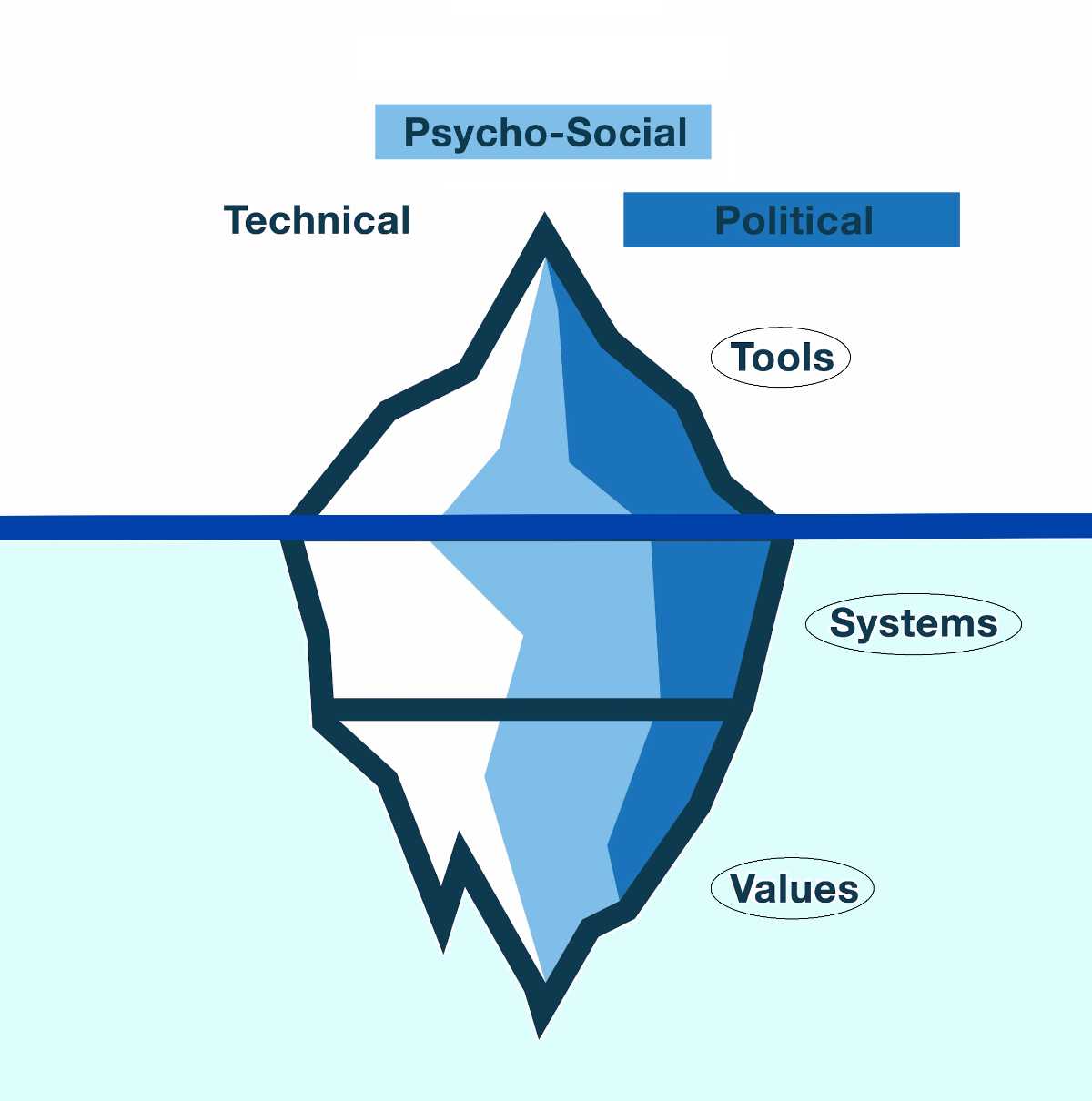
Technology Education Iceberg by Jacob Pleasants, Dan Krutka, & Phil Nichols
License: CC-BY-NC-4.0
The iceberg at a glance
The model was originally developed for reflection on technology use in educational contexts in general. The model consists of 3 x 3 different dimensions and can be read from left to right. The three different colour shades represent the technical, psychosocial and political dimensions of the technology used. The three horizontal areas represent the visible level of technology as a tool, the level of embedded and invisible information technology systems, and the third level represents the values and attitudes underlying the technology.
Level 1: Tools (visible) Technical: At this level, the focus is on the structure and functioning of the technology used. In particular, it is about what a specific tool is used for, how it performs this function and how well it does so.
Psychosocial: This level focuses on what the respective use of technology enables, what actions it suggests and why people might want this – in other words, the immediate effect on perception, action and cooperation.
Political: This level focuses on who developed the technology and who decides on its design and use. Equally important are the rules that structure its use (access, limits, responsibilities).
Level 2: Systems (invisibly embedded) Technical: Technologies are usually embedded in comprehensive infrastructures (networks, databases, clouds, etc.). Therefore, the focus here is on how this embedding is specifically designed, how it is operated/maintained, and what consequences it has for other systems (e.g. work processes, environment, health).
Psychosocial: When a particular technology is introduced into unfamiliar contexts (e.g. in specialist teaching), it can change practices: working methods, routines, the organisation of learning and collaboration. The question here is how and to what extent these changes occur.
Political: This asks who is allowed to make decisions and why. These decisions include formal and informal rules and regulations, as well as the question of what happens when rules are broken or groups remain excluded.
Level 3: Values (deep-seated, guiding action)
Technical: Technologies reflect the goals and norms of human coexistence. Their areas of application, modes of action and contexts reveal the fundamental values and attitudes that underpin their development and use. Such reflection also leads to questions of alternative design and use (e.g. focused on transparency, traceability, resource conservation).
Psychosocial: Technology reinforces or undermines cultural practices and social values. The question is therefore which forms of personal expression, identity, cooperation and recognition are strengthened – and which are neglected.
Political: Here, it becomes apparent how technology reflects power relations: whose concerns it prioritises, to whom it gives power to act, how rules are created and enforced, and whether existing conditions are maintained, stabilised or challenged.
The iceberg applied specifically to AI services
In the case of AI services, the interrelationships between the iceberg dimensions outlined above apply in a particularly condensed form. The first level to be visible is the tool level: many offerings are publicly accessible and appear to have a low threshold, but at the same time they almost always depend on a stable, permanent internet connection. Access is often tied to accounts, usage limits or payment models; the range of functions, export options and runtimes are based on platform logic and can change at short notice. For teaching, this means that the tangible aspects on the surface – operation, speed, immediate listening – are dependent on infrastructure, availability and terms and conditions from the outset.
The system level operates beneath the surface. Here, data sources, model versions, update cycles, licensing and data protection regulations, and integration into school IT structures determine what is possible and what is not. Changes to the model can alter the sound and results unnoticed in the background, often overnight; access options, data flows and server locations determine how outputs may be further processed. Resource requirements – from the network to end devices to computing power in the cloud – are also part of this system logic. Since many services have only been tested sporadically in teaching scenarios to date, routines and legal regulations are lacking; testing them in the classroom therefore presents an educational, organisational and often legal challenge.
Even deeper lies the values level, which guides actions at a fundamental level. This is where transparency regarding human and machine involvement, protection of voice and personality, fairness and participation, legal compliance and ecological responsibility are anchored. Payment barriers and account requirements raise questions of accessibility; platform lock-in and dependencies often call into question legal sovereignty and educational integrity.
Taken together, this means that tools show what is immediately feasible, systems explain what makes this possible and what limits it, and values guide how technologies are developed and applied.
Further ideas based on the iceberg model
The following questions, based on the iceberg model, help teachers to objectively classify and select services and providers for music lessons. At the same time, they serve as a starting point for reflecting on the opportunities, limitations and framework conditions of music-related AI together with learners. The wording is deliberately kept open and can be adapted or expanded depending on the type of school, learning group and context.

Iceberg Model English
Lizenz: CC-BY-NC-4.0
Sources and further reading:
- Pleasants, J., Krutka, D. G., & Nichols, P. (n.d.). Introducing the technology education iceberg. Retrieved from https://www.civicsoftechnology.org/blog/introducing-the-technology-education-icerberg
- Krutka, D. G., Pleasants, J., & Nichols, T. P. (2023). Talking the technology talk. Phi Delta Kappan, 104(7), 42–46. https://drive.google.com/file/d/19-2gTiTEBaEUBkvunvm2JqKJeUOkFcPM/view

Licence: The logos shown are excluded from the CC-BY-SA-4.0 licence.
The development and delivery of this training course by the Freiburg University of Music and the Freiburg University of Education in cooperation with educators from the ZSL Freiburg is part of the KuMuS-ProNeD project.
The development and creation of the original version of these materials is funded by the European Union – NextGenerationEU and supported by the Federal Ministry of Education, Family, Seniors, Women and Youth. Further information can be found at lernen.digital. The views and opinions expressed are solely those of the author(s) and do not necessarily reflect the views of the European Union, the European Commission or the Federal Ministry of Education, Family, Seniors, Women and Youth. Neither the European Union, the European Commission nor the Federal Ministry of Education, Family, Seniors, Women and Youth can be held responsible for the content.
The logos shown are excluded from the CC-BY-SA-4.0 licence.