Design in a nutshell by TEAM - Democracy in Music Education - License: CC-BY-4.0
Who sets the tone here?
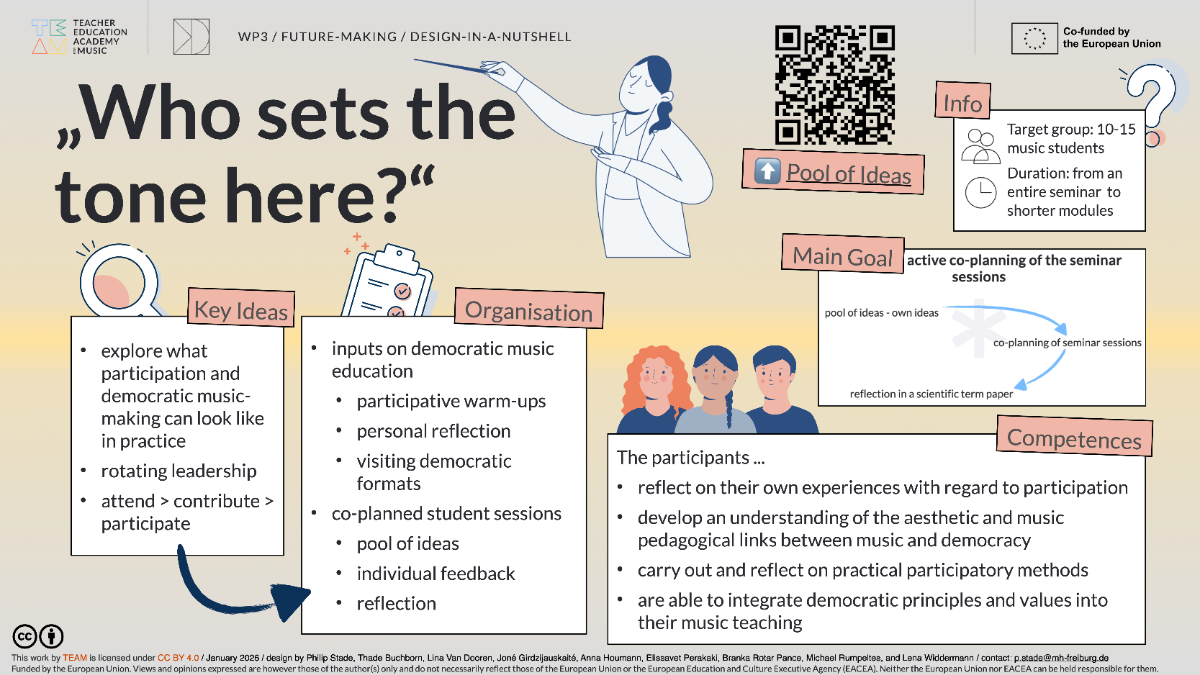
This is a modular seminar concept for democratic music education and participation by TEAM that follows several design principles specially developed for the basis of a democratic seminar structure. These principles reflect how to interact in this seminar and are transferable to any common learning situation. The main aim of this seminar is to actively plan the seminar sessions together with the participants. An online collection of directions in which "participatory music-making" could be conceived, serves as a source of ideas. This design is strongly connected to "Democracy in Music Education".
Module 1
Module 1: Democratic and Participatory Warm-Ups
This module explores the role of warm-ups as a central element in learning settings. Emphasis is placed on implementing warm-ups in a democratic and participatory way, encouraging all learners to contribute and take ownership of the process. The module also invites reflection on how warm-ups can set the tone for productive and supportive learning environments. By the end of the module, students will be able to plan and lead warm-up exercises that are engaging, participatory, and pedagogically meaningful.
The YouTube Channel "Pass the Sound" is a great collection of participative warm-ups. Check it out! Source: YouTube
Module 2
Module 2: Basic Elements of Participation
How do we interact with one another, and how do we communicate within the context of music education? This question invites reflection on the ways students and teachers exchange ideas, give feedback, and collaborate musically. It also encourages consideration of the social and emotional dimensions of communication, such as listening, empathy, and respect, which are essential for creating inclusive and participatory learning environments. In this module you can find some suggestions as hand signals for communicating and feedback exercises.

Hand Signals by Yug, CC BY-SA 4.0
Note‼️: Following feedback, a gesture of rejection consisting of two forearms forming an “X” was removed from the group repertoire, as it was perceived as too confrontational in body language and had a similar effect to a direct answer.

This work 5 Finger Feedback by Philip Stade is licensed under CC BY 4.0
Module 3
Module 3: Self-Reflection on Participation and Democracy
In this brief exercise, each participant records their reflections, either by writing them down or creating a voice memo, on the self-reflection questions below, focusing on democracy and participation (see below⬇️).
See the other Design of the TEAM project: Workshop on Democracy and Participation in Music Education

Module 4
Module 4: Collective Reflection on Participation and Democracy Education
Below, three methods for fostering reflection in the (music) classroom are introduced and explained in detail:
(1) reading and discussing transcripts,
(2) the Ladder of Participation and
(3) the Reference Framework of Competences for Democratic Culture (RFCDC).
The Ladder of Participation helps students and educators understand different levels of involvement, from passive observation to active decision-making, encouraging more meaningful engagement. The RFCDC provides a structured framework for developing and assessing the knowledge, skills, and attitudes that support democratic culture, guiding reflection on both individual and group learning processes. Together, these tools offer practical ways to integrate democratic principles and participatory practices into classroom activities.
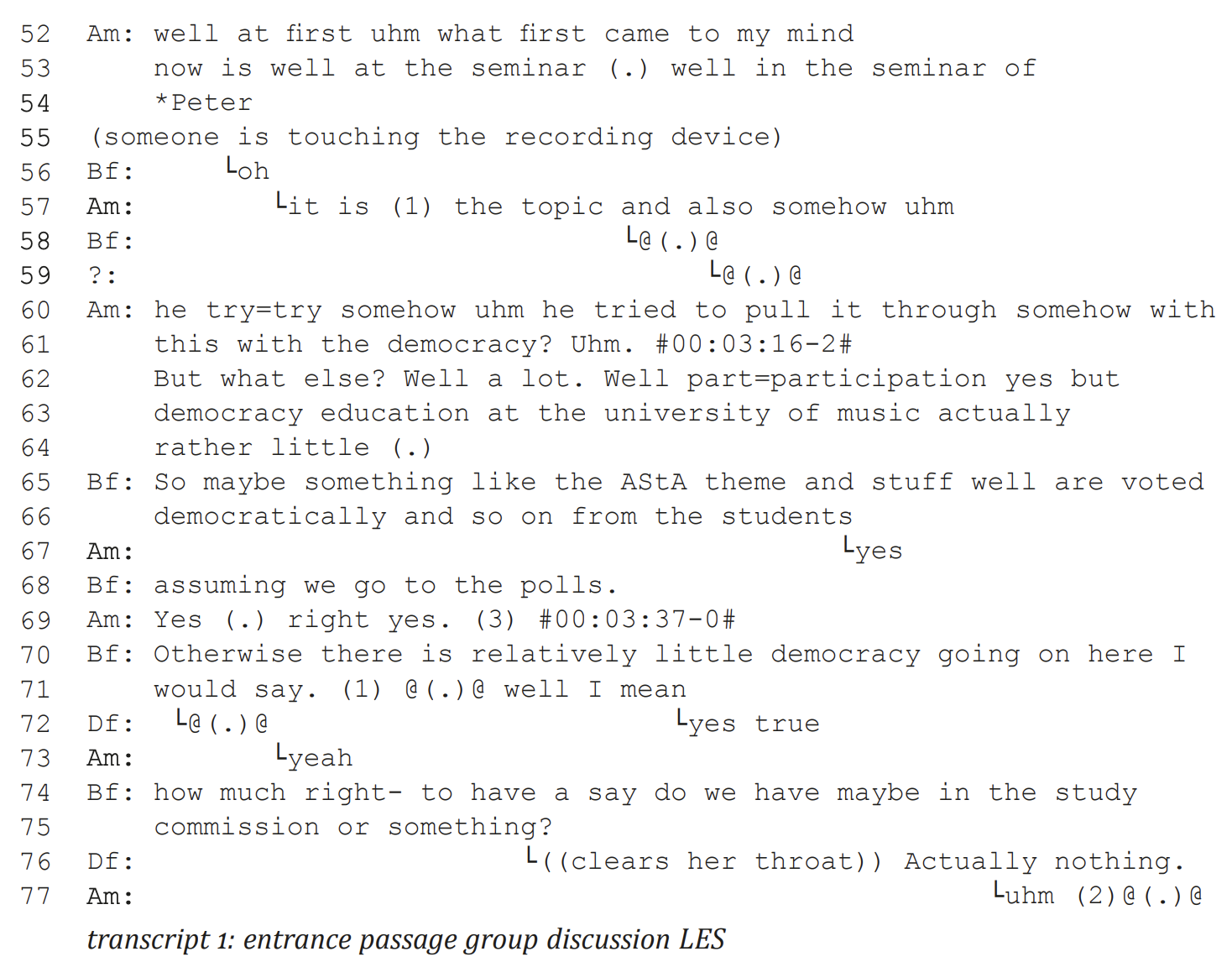
Entrance passage of a group discussion between music students on democracy and participation - License: CC-BY-4.0

License CC-BY 4.0. Author: Rosso Robot, using: Hart, Roger (1992). "Children's Participation: From Tokenism To Citizenship". Wikimedia
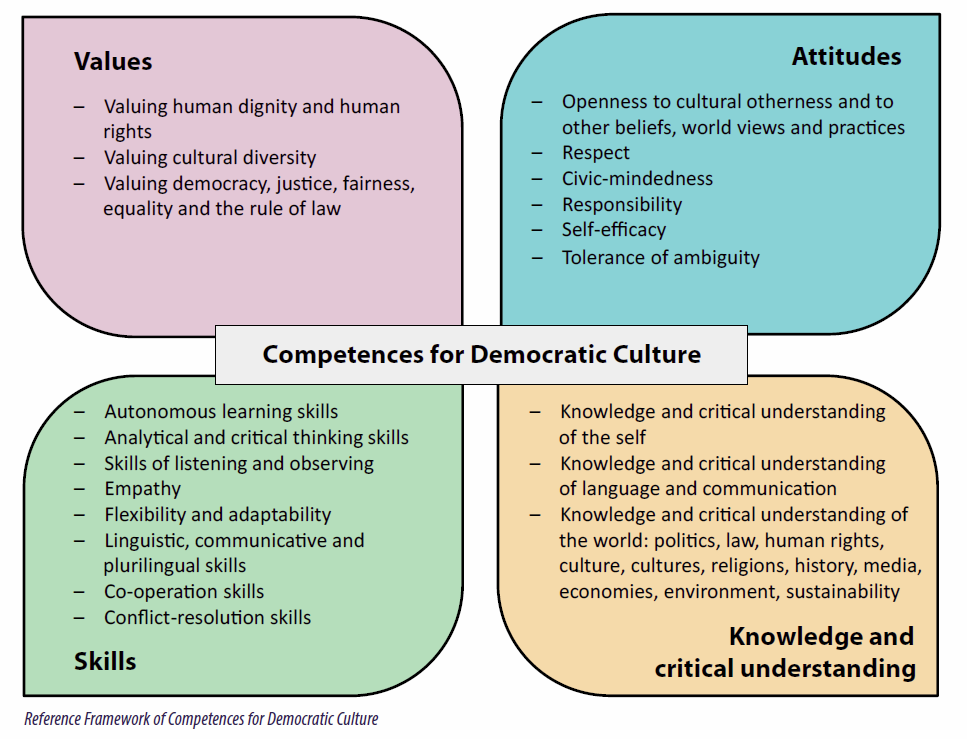
The RFCDC with its four petals (No CC-License!). Competences for Democratic Culture by the Council of Europe
Module 5
Module 5: Defining Democracy and Democracy Education - Six General Impulses
So what does democracy actually mean, and how can these principles be applied in the context of music education? In the sections below, we offer several attempts to define democracy, highlighting its core values such as participation, inclusion, equality, and shared decision-making. We also explore practical ideas and strategies for making music lessons more democratic, emphasizing ways to give students a voice, encourage collaborative learning, and balance teacher guidance with student agency. By connecting democratic theory with classroom practice, these examples aim to inspire educators to create learning environments where all participants feel respected, empowered, and actively involved in shaping their musical experience.
 Veto
VetoFollowing Maike Plath's (2023)"Veto Principle", everybody is allowed to say "Veto" at any time. What could that mean for your music lessons?
 Liberating Structures
Try out some of the Liberating Structures to have more engaging and participatory methods in music lessons.
 Student Council
How do the students organize themselves, and how can this be applied to music lessons?
 Subject, Consumer or Citizen?
Reflect on the Citizen-Story by Jon Alexander (2023): Are we subjects, consumers or citizens in the music classroom?
 Values
Which values are important to you? Select 1-3 and begin to reflect music education from this perspective.
 Children’s Rights
Explore the Convention on the Rights of the Child in a child-friendly version. Are all rights taken into account in music class? What to improve?
Module 6
Module 6: Connecting Music and Democracy in Student Sessions
Following the design principles of the seminar, the schedule will vary each time, as the seminar leader continuously adapts the program in an agile way together with the students. This flexible approach allows participants to shape the learning experience according to their interests, needs, and emerging ideas. Below, you will find a range of ideas and sources of inspiration for integrating the principles of democracy into both music lessons and the seminar itself. These examples encourage participatory decision-making, collaborative exploration, and creative engagement, helping to foster an inclusive and reflective learning environment.
 Pool of ideas for democratic / participatory music making
Get inspired by this huge and growing pool of ideas.
Getting started |
|---|
Self-reflection with voice recordings / organisation / collection of questions (see above ) |
Reflecting and defining participation and democracy in music education (see above) |
Exercise on good feedback (see above ) |
Collective planing of the student sessions |
Student sessions (participants plan and lead sessions - in seminar or in school settings) |
1) Student session "mindful music education": This session explored how mindfulness practices such as "The toolbox is you" can be integrated into music education to enhance listening, presence, and reflective learning processes. |
2) Student session "free improvisation": The session focused on free improvisation as a space for creative freedom, collective interaction, and non-hierarchical music-making. |
3) Student session "music of young people and movement": This session examined the music cultures of young people and connected them with movement as a means of embodied musical expression. |
4) Student session "orchestral/choral music without a conductor?": The session investigated possibilities of choral music-making with and without a conductor, comparing shared responsibility, communication, and democratic structures. |
5) Student session "(anti-) discrimination and inclusion": This session started discussions on (anti-)discrimination and inclusion in music education and how hidden power structures shape the music classes. Interim 5 finger-feedback and discussion of the feedback (see above) |
6) Student session "classical improvisation": The session explored classical improvisation as a way to reconnect historical practices with contemporary creative learning in music education. |
7) Student session "motions through colour?": This session focussed on visual approaches by exploring how emotions can be expressed through colour. |
8) Student session "soundscapes": Soundscapes offer low-barrier access to listening and raise awareness of the surrounding environment. |
9) Student session "art of the hour": The session experimented with short, time-based artistic processes to encourage spontaneous creativity and interdisciplinary artistic thinking. |
10) Student session "hymns": Create a class anthem and reflect on principles of anthems. |
11) Student session "music taste": Do We Like What We Hear – Or Hear What We Like? Explore your music taste and practice conscious listening. |
12) Student session "influenced by music": How does music influence our daily life? Explore how music affects you and how you use it. |
... |
End of the seminar |
Self-reflection with voice recordings - The participants listen to or read their own reflection from the beginning of the seminar: What has changed since then? Preparation of seminar papers |
Group discussion (see other TEAM design "Democracy in Music Education") |
Conceptualisation & Implementation: Philip Stade, Elisabeth Theisohn & Johanna Klingenberg
Evaluation & Re-design: Philip Stade & Thade Buchborn
Review & Editing: Thade Buchborn, Jonė Girdzijauskaitė-Pocienė, Anna Houmann, Veronika Jetter, Elissavet Perakaki, Branka Rotar Pance, Michael Rumpeltes, Philip Stade, Lina Van Dooren & Lena Widdermann
Visualisation & OER Design: Philip Stade & Lena Widdermann
Contact: p.stade@mh-freiburg.de

