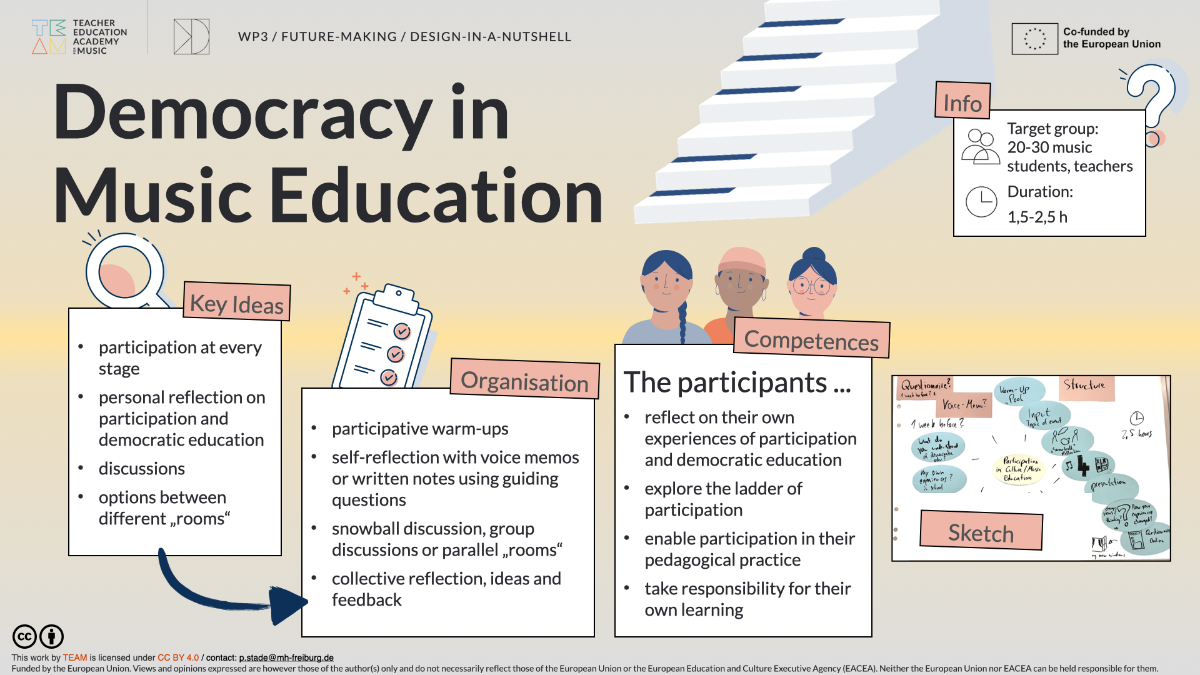
TEAM Design in a nutshell - Democracy in Music Education - License: CC-BY-4.0
Democracy in Music Education
A Modular Workshop on Democracy and Participation in Music Education by TEAM
Module 1
Module 1: Democratic and Participatory Warm-Ups
This module explores the role of warm-ups as a central element in learning settings. Emphasis is placed on implementing warm-ups in a democratic and participatory way, encouraging all learners to contribute and take ownership of the process. The module also invites reflection on how warm-ups can set the tone for productive and supportive learning environments. By the end of the module, students will be able to plan and lead warm-up exercises that are engaging, participatory, and pedagogically meaningful.
The YouTube Channel Pass the Sound is a great collection of participative warm-ups. Check it out! Source: YouTube
Module 2
Module 3
Module 3: Group Activities
The following activities provide a variety of ways for participants to engage, share their perspectives, and exchange ideas. They can be adapted to fit the specific goals, interests, and composition of your group, allowing for flexible participation and collaboration. By offering multiple approaches, these activities encourage reflection, dialogue, and creative interaction among all members.
Module 4
Module 4: Collective Reflection
Below, two methods for fostering reflection in the classroom are introduced and explained in detail: the Ladder of Participation and the Reference Framework of Competences for Democratic Culture (RFCDC). The Ladder of Participation helps students and educators understand different levels of involvement, from passive observation to active decision-making, encouraging more meaningful engagement. The RFCDC provides a structured framework for developing and assessing the knowledge, skills, and attitudes that support democratic culture, guiding reflection on both individual and group learning processes. Together, these tools offer practical ways to integrate democratic principles and participatory practices into classroom activities.

License CC-BY 4.0. Author: Rosso Robot, using: Hart, Roger (1992). "Children's Participation: From Tokenism To Citizenship". Wikimedia
Module 5
Module 5: Defining Democracy and Democracy Education - Six General Impulses
So what does democracy actually mean, and how can these principles be applied in the context of music education? In the sections below, we offer several attempts to define democracy, highlighting its core values such as participation, inclusion, equality, and shared decision-making. We also explore practical ideas and strategies for making music lessons more democratic, emphasizing ways to give students a voice, encourage collaborative learning, and balance teacher guidance with student agency. By connecting democratic theory with classroom practice, these examples aim to inspire educators to create learning environments where all participants feel respected, empowered, and actively involved in shaping their musical experience.
 Veto
VetoFollowing Maike Plath's (2023)"Veto Principle", everybody is allowed to say "Veto" at any time. What could that mean for your music lessons?
 Liberating Structures
Try out some of the Liberating Structures to have more engaging and participatory methods in music lessons.
 Student Council
How do the students organize themselves, and how can this be applied to music lessons?
 Subject, Consumer or Citizen?
Reflect on the Citizen-Story by Jon Alexander (2023): Are we subjects, consumers or citizens in the music classroom?
 Values
Which values are important to you? Select 1-3 and begin to reflect music education from this perspective.
 Children’s Rights
Explore the Convention on the Rights of the Child in a child-friendly version. Are all rights taken into account in music class? What to improve?
Module 6
Module 6: Connecting Music and Democracy
Here are several ideas and sources of inspiration for integrating the principles of democracy into music lessons. These suggestions aim to support student participation, collaboration, and shared decision-making, while also fostering creativity and musical engagement. By exploring these approaches, educators can design activities that encourage learners to express their ideas, take initiative, and contribute meaningfully to the collective musical experience.
 Pool of ideas for democratic / participatory music making
Get inspired by this huge and growing pool of ideas.

This work 5 Finger Feedback by Philip Stade is licensed under CC BY 4.0
-
Conceptualisation: Elissavet Perakaki, Branka Rotar Pance, Michael Rumpeltes & Philip Stade
-
Implementation & Evaluation: Thade Buchborn, Elissavet Perakaki, Branka Rotar Pance, Michael Rumpeltes & Philip Stade
-
Re-design, Review & Editing: Thade Buchborn, Lina Van Dooren, Jonė Girdzijauskaitė-Pocienė, Anna Houmann, Elissavet Perakaki, Branka Rotar Pance, Michael Rumpeltes, Philip Stade & Lena Widdermann
-
Visualisation & OER Design: Philip Stade & Lena Widdermann
Contact: Philip Stade p.stade@mh-freiburg.de

