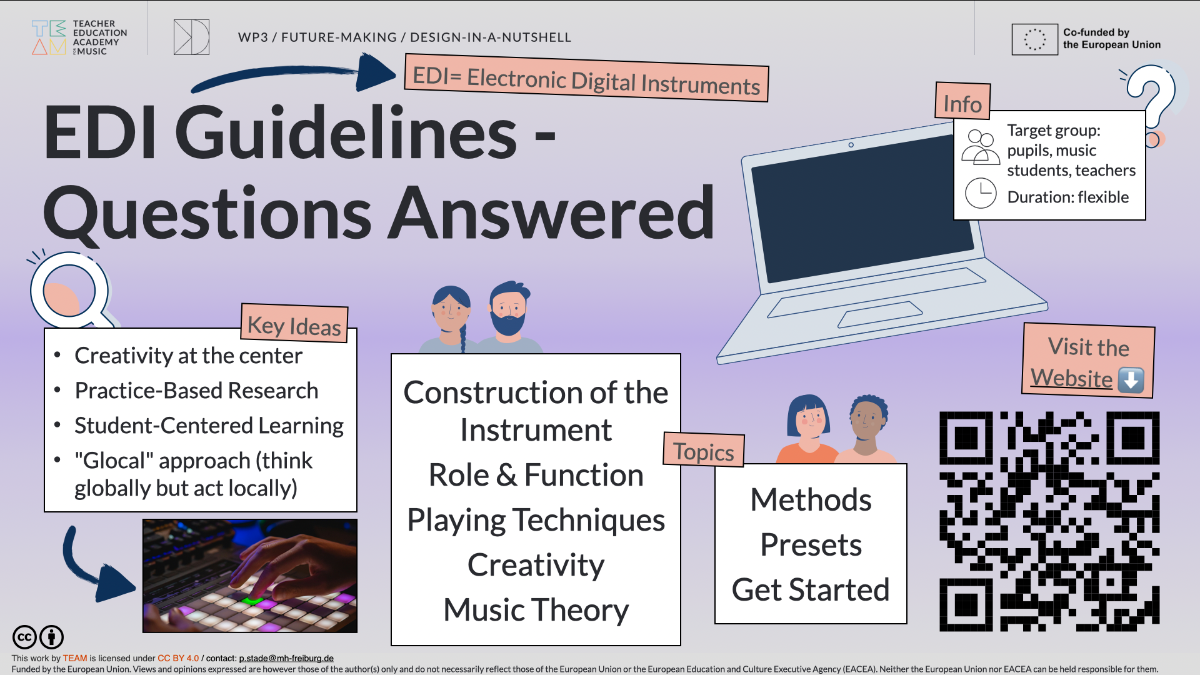
EDI Guidelines: Navigating Electronic Digital Instruments in Music Education – Questions Answered
This resource presents the results of "The Digital Student," a practice-based research project (2021–2024) exploring the computer as a musical instrument. It offers a comprehensive collection of materials, teaching methods, and reflections designed to support teachers and students in integrating Electronic Digital Instruments (EDI) into both individual and ensemble music education.
Module 1
Module 1: Frequently Asked Questions on the EDI Guidelines (FAQs)
The EDI Guidelines serves as a support system for teaching music with digital tools. They provide films, method exercises, and "field observations" based on real-world classroom cycles. Because the field of digital music is in constant change, these guidelines are an evolving resource meant to inspire rather than dictate a "recipe" for success.
 How do I build an EDI setup?
Learn about the necessary hardware and software configurations
- What is the role of an EDI player in a band?
Explore how EDI can double as bass, drums, or lead melody in an ensemble
- What playing techniques are unique to EDI
Discover techniques like finger drumming, live looping, and real-time effects processing
- Can I use EDI to teach music theory?
See how controllers provide instant visual feedback on rhythm, harmony, and form
- What are the best methods for ensemble teaching?
Explore "production-like" repetitions and process-driven lessons
- What equipment is required to get started?
View the technical requirements for a functioning EDI classroom
- How do I set up my software for a live performance?
Get tips on preparing tracks and sound sources for live interaction
- How can EDI enhance student creativity?
Understand how sound design and instrument configuration foster musical innovation
Module 2
Module 2: Behind the EDI Guidelines
The EDI Guidelines are the culmination of the project "The Digital Student - challenges and opportunities using EDI in Swedish music education". This initiative was part of a national pilot project aimed at strengthening the link between scientific research and proven experience in schools.

This work 5 Finger Feedback by Philip Stade is licensed under CC BY 4.0
-
Conceptualisation, Implementation, Evaluation & Re-Design: Anna Houmann, Joakim Barfalk, Per Berlin Englund & Erik Lundahl
-
Review & Editing: Thade Buchborn, Lina Van Dooren, Jonė Girdzijauskaitė-Pocienė, Anna Houmann, Elissavet Perakaki, Branka Rotar Pance, Michael Rumpeltes, Philip Stade & Lena Widdermann
-
Visualisation & OER Design: Philip Stade & Lena Widdermann
Contact: p.stade@mh-freiburg.de
