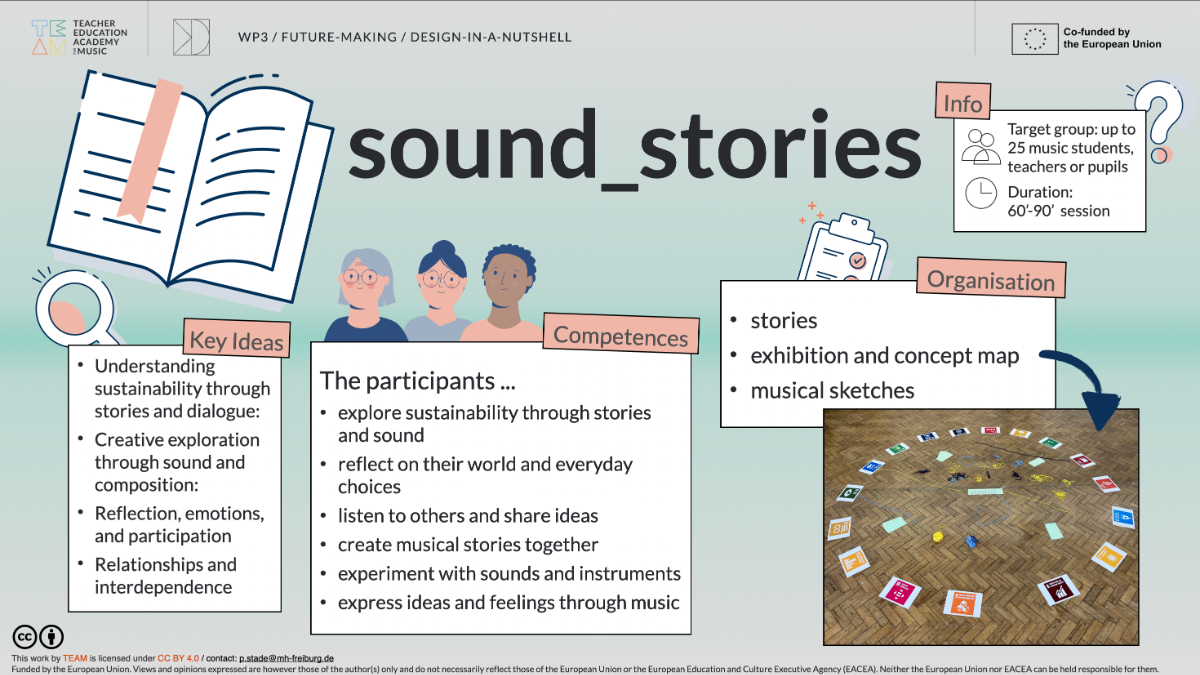
sound_stories - TEAM Design-in-a-nutshell - License: CC-BY-4.0
Sound_Stories
A modular workshop on sustainability in music education
Module 1
Module 1: Understanding Sustainability
This module introduces sustainability through stories, listening, and collaborative exploration. Participants reflect on relationships between people, environments, and everyday practices while recognising that sustainability can be understood in different ways.
Participants will...
- explore sustainability through stories, sound and dialogue
- listen to and share different perspectives
- reflect on people, places, and environments
Suggested duration
30-45 minutes
Pathway A: preparation
- Choose a story and select relevant episodes
- Optional visualisations for the story
Pathway B: preparation
- Papers/cards and markers
- Yarn/strings for collaborative concept mapping
- Optional sustainability exhibition materials
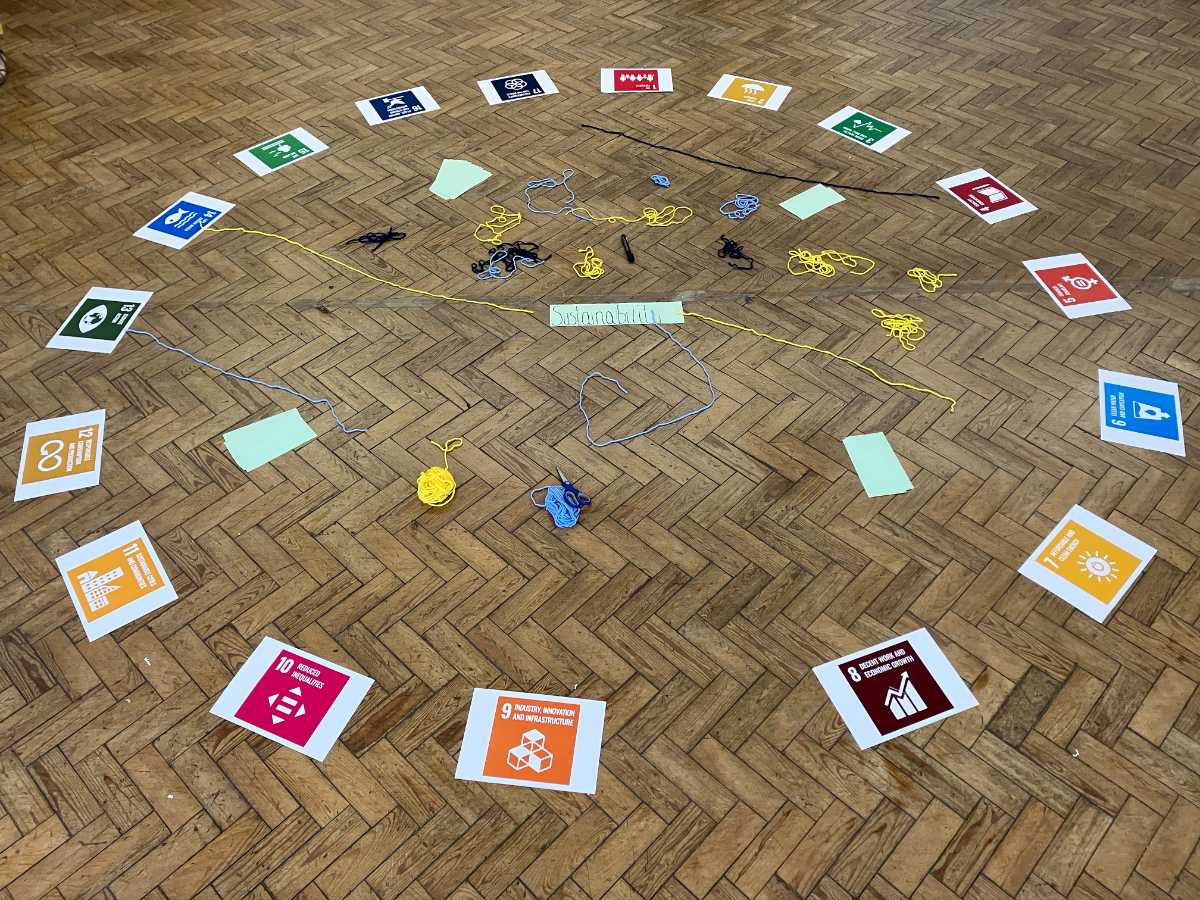
sound_stories - concept map on sustainability and music - License: CC-BY-4.0
💦 Compositions with water
Students explore sound by making music with water: swirling, blowing through straws, experimenting with how water levels change the sound, etc. While creating, they learn that clean water is precious. The activity sparks conversations about water use, pollution, and how recycling and careful habits help keep our water sources healthy.
🏞 Compositions to portray nature
Students compose pieces inspired by nature using musical elements. They choose a genre, scale, or specific instruments to portray a natural process, such as a volcano erupting or a seed growing. By musically representing natural phenomena, students learn about biodiversity, ecosystems, and why protecting habitats and natural processes is vital.
🌍 Project Around The Globe
Students listen to, perform, and create music from cultures around the world, exploring different rhythms, melodies, and instruments. They imagine traveling to these places in sustainable ways, by train or sailboat, and reflect on global cultural diversity, understanding how communities around the world live, celebrate, and face environmental challenges.
🌿 Project #Savetheamazon
Students learn samba by first focusing on rhythm, then adding melodic instruments. They experience the energy and teamwork needed to play Brazilian music. They discover the importance of the Amazon rainforest, learning about Indigenous peoples, the threat of deforestation, and how the forest helps clean the air for the whole planet.
👣 Soundwalk improvisation
Students go on a soundwalk, listening carefully to their environment, then use those impressions to improvise music. This helps them notice the qualities of their local area, whether rural or urban, clean or polluted, quiet or busy, and consider how human activity affects the natural soundscape and living creatures.
🙋🏽♀️ Student-led exhibition
Interdisciplinary project where students compose or perform protest songs about an issue they care about. Their music becomes part of an exhibition, performed live or shared at listening stations. They learn to communicate important socio‑ecological topics across subjects and use music as a tool for awareness, advocacy, and positive change.
🎵 Music with a societal purpose
Students rehearse and perform in small ensembles, creating a short concert program. They bring their music to places that need it, such as nursing homes, children’s events, or charity fundraisers, learning how music supports community well‑being and can contribute to meeting social needs. 🛠️ The TEAM leaning offer "Musical Social Hours" - soon available 🛠️
👂🏽 Soundscapes
Students create soundscapes by combining musical ideas with environmental sounds or found objects. These connect to what they experienced during a soundwalk. Through exploring their environment, they learn how natural and human‑made sounds reflect the health, identity, and needs of that place.
Module 2
Module 2: Composing Sustainability
In this module, participants transform ideas, emotions, and reflections about sustainability into sound and music. Through creative exploration, they compose short musical stories inspired by people, environments, relationships, and everyday experiences in smaller groups. There is a lot of flexibility in how you approach and design the composition task depending on the group size, available time and the focus of inquiry. Examples can be groups of 3-5, composition length as short as 30 seconds, must include the use of syncopation, etc.
Participants will...
- create musical stories connected to sustainability
- experiment with sounds, instruments, and musical ideas
- collaborate creatively through music-making
Suggested duration
20-40 minutes
Preparation
- A selection of your/pupils' choice: instruments, natural resources, waste objects
- Posters of musical elements with or without ideas connected to sustainability
- A few back-up stories/scenarios for those participants who struggle to come up with their own
- Recording devices (optional)
- Paper/cards for writing down ideas (optional)
Module 3
Module 3: Reflecting on sustainability
This module invites participants to reflect on the ideas, emotions, and perspectives that emerged during the workshop. Through listening and dialogue, participants explore connections between sustainability, music, everyday life, and their own experiences.
Participants will...
- reflect on sustainability through music and dialogue
- listen to and respond to different perspectives
- connect workshop experiences to their own lives
Suggested duration
15-30 minutes

This work 5 Finger Feedback by Philip Stade is licensed under CC BY 4.0
Literature and further reading
Below you will find a curated selection of readings and resources related to sustainability, music education, storytelling, emotions, and participatory learning. The resources are organised by theme to help you quickly find the type of inspiration or background you are looking for.
Some resources offer practical classroom ideas, while others provide research-based perspectives, stories, or accessible introductions to sustainability in music education. You do not need to read everything - feel free to explore according to your interests, teaching context, or level of experience.
🟢 Getting started accessible introductions to sustainability and music education
🟡 Classroom inspiration practical ideas, activities, and teaching examples
🔵 Deep dive research and theoretical perspectives for further exploration
🟣 Stories & perspectives narratives, lived experiences, and case-based perspectives
Sustainability and music education
Recommended if you are new to sustainability in music education and would like an accessible introduction.
🟢 🟡 Music Lessons for a Living Planet: Ecomusicology for Young People
Shevock, D. J., & Bates, V. C. (2024). Music Lessons for a Living Planet: Ecomusicology for Young People. Routledge.
Accessible introduction with practical examples for younger learners.
🟢 Bates, V. C. (2024). Sustainable Futures and School Music. In The Sage Handbook of School Music Education (pp. 52–66). Sage Publications.
A concise overview of sustainability and school music education.
🔵 Foster, R., & Sutela, K. (2024). Ecosocial approach to music education. Music Education Research, 26(2), 99–111.
Introduces an ecosocial perspective on music education and sustainability.
Practical ideas and classroom inspiration
Recommended if you are looking for concrete examples of how sustainability can connect with music teaching.
🟡 Barcellos, L. C., & Wade-Chung, R. (2022). #SaveTheAmazon: Promoting global competence and making bridges in the middle school music classroom. Journal of Popular Music Education, 6(3), 403–421.
Example of connecting sustainability and global competence in music education.
🟡 🔵 Shevock, D. J. (2017). Eco-Literate Music Pedagogy. Routledge.
Practical and philosophical ideas for ecological music pedagogy.
🟡 Schmid, S., Völker, J., Eusterbrock, L., & Weidemann, L. (2023). Musik-Klima.
Practical examples and teaching resources connecting music and climate.
Emotions, dialogue, and participation
Recommended if you want to support dialogue, emotions, and multiple perspectives when teaching sustainability.
🟡 🔵 Ojala, M. (2013). Emotional Awareness: On the Importance of Including Emotional Aspects in Education for Sustainable Development (ESD). Journal of Education for Sustainable Development, 7(2), 167–182.
Helpful for working with emotions, uncertainty, hope, and dialogue in sustainability education.
Stories and sustainability
Recommended if you would like to work with storytelling and sustainability-related perspectives.
🟣 Watt-Cloutier, S. (2015). The Right to Be Cold. University of Minnesota Press.
A personal and political story connecting climate change, Indigenous perspectives, and lived experience.
🟣 🔵 Lawrence, R. (2014). Internal colonisation and Indigenous resource sovereignty: wind power developments on traditional Saami lands. Society and Space, 32, 1036–1053.
Useful for discussing conflicting perspectives and sustainability dilemmas (“wicked problems”).
Sustainability frameworks and background
Recommended if you would like a broader overview of sustainability.
🟢 United Nations (2015). Sustainable Development Goals (SDGs).
General overview of global sustainability goals and themes.
-
Conceptualisation, Implementation, Evaluation & Re-design: Lina Van Dooren, Jonė Girdzijauskaitė-Pocienė, Philip Stade
-
Review & Editing: Thade Buchborn, Lina Van Dooren, Jonė Girdzijauskaitė-Pocienė, Anna Houmann, Elissavet Perakaki, Branka Rotar Pance, Michael Rumpeltes, Philip Stade & Lena Widdermann
-
Visualisation & OER Design: Philip Stade & Lena Widdermann
Contact: p.stade@mh-freiburg.de
