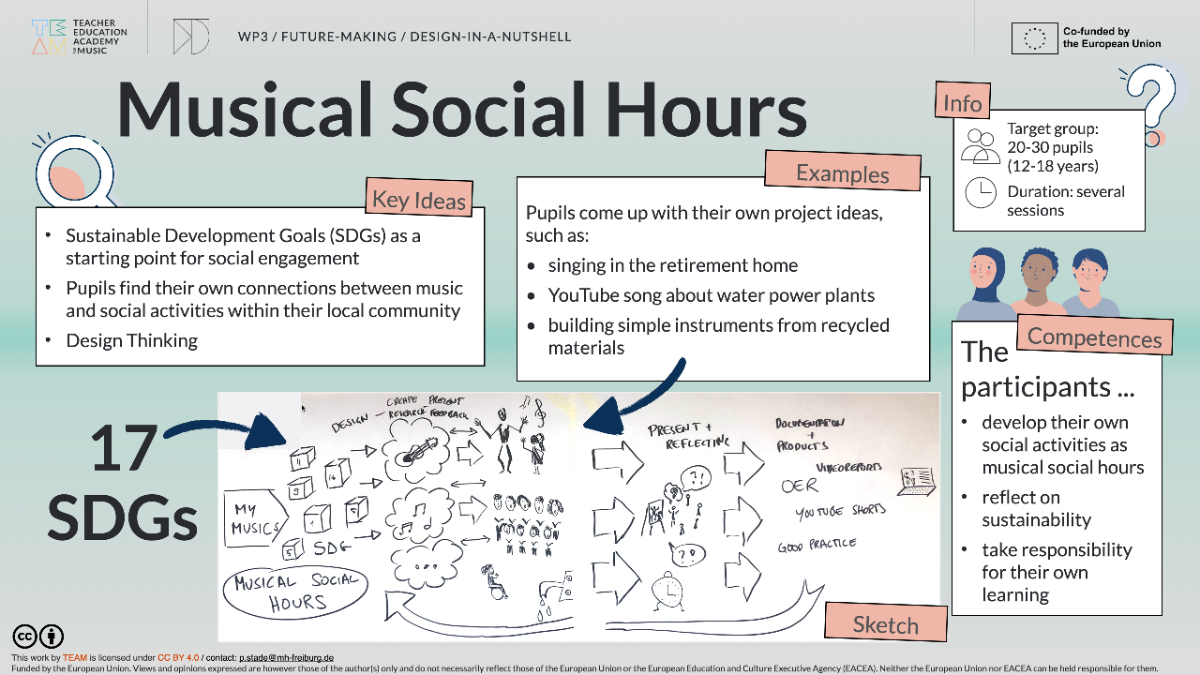
TEAM Design-in-a-nutshell - Musical Social Hours - License: CC-BY-4.0
Musical Social Hours
Module 1
Module 1: Connecting SDGs and music to social hours
This module introduces the relationship between the United Nations Sustainable Development Goals (SDGs) and musical practice in social contexts. It explores how music can serve as a medium for reflection, awareness, and engagement with global challenges such as equality, education, health, and sustainability.
Source: YouTube
Module 2
Module 2: Finding ideas for possible Musical Social Hours.
In this module, participants develop creative concepts for “Musical Social Hours” by linking musical activities with concrete social and community-oriented themes. The emphasis is on finding ideas and the adaptation of musical resources for diverse target groups.
Design thinking and design sprints are approaches for visually sketching out as many ideas as quickly as possible. The following rules apply to our context.
- No digital devices in the room. 📴
- Group brainstorms don’t work, so you’ll sketch alone. 👤
Okay: Let´s have fun! 🎉
- Sketch your ideas! "The quantity is it." "Dare to be wild!" "Be visual." (20 Min.)
- After the sketching: Choose your best sketches and present them. (20 Min.)
- Give feedback: "Avoid criticism." (20 Min.)
✏️📃 Material: Pens, pieces of paper, post-its, posters
⌛️ Duration: approx. 60 minutes.
Sources: Knapp, J., Zeratsky, J., & Kowitz, B. (2016). Sprint: How to solve big problems and test new ideas in just five days. Simon & Schuster. Knapp, J. (2018). SPRINT kickoff slides
Module 3
Module 3: Implementing Musical Social Hours ideas into practice.
This module focuses on translating previously developed concepts into real-world musical practice. Participants test, refine, and reflect on their “Musical Social Hours” in practical settings, considering pedagogical, artistic, and social dimensions. From a didactic standpoint, the emphasis lies on experiential learning and reflective practice, enabling participants to bridge the gap between concept and implementation in socially engaged music education.
1) Develop a timeline 🗓️
Start by planning your process over time. Define clear phases (e.g., idea development, contact phase, cooperation phase, implementation). Set realistic milestones and consider how much time each step will require.
2) Get in contact with the (local) community 📞
Identify relevant local actors such as schools, cultural institutions, social organizations, or music initiatives. Reach out to them actively and present your initial ideas in a clear and open way.
3) Build up cooperations 🤝
Develop sustainable collaborations based on mutual interests. Clarify roles, expectations, and possible contributions of each partner to ensure a productive and realistic cooperation.
4) Put your ideas in practice with partners 🚀
Refine your initial concepts through exchange with your cooperation partners. Adapt your ideas to real-life contexts and start testing them in practical settings, allowing space for feedback and adjustment.
Reflection / Feedback
Following the completion of the Social Hours project, reflection together with the cooperation partners is essential. This reflection helps to evaluate the outcomes of the project and to identify what has worked well and what could be improved in future collaborations. It also provides an opportunity to discuss mutual feedback, strengthen partnerships, and ensure that the social impact of the project is clearly understood and documented.

This work 5 Finger Feedback by Philip Stade is licensed under CC BY 4.0
Conceptualisation: Thade Buchborn & Jonė Girdzijauskaitė-Pocienė
Implementation & Evaluation: Jonė Girdzijauskaitė-Pocienė
Re-design, Review & Editing: Thade Buchborn, Lina Van Dooren, Jonė Girdzijauskaitė-Pocienė, Vaiva Šaulienė, Anna Houmann, Elissavet Perakaki, Branka Rotar Pance, Michael Rumpeltes, Philip Stade & Lena Widdermann
Visualisation & OER design: Philip Stade & Lena Widdermann
Contact: p.stade@mh-freiburg.de
